
To mark the anniversary of note ban, the Congress was observing a 'black day'.

'We do not want people who are air dropped and who fly out once the job is done.' 'Ever since liberalisation started, we keep on hearing that it's going to be jobless growth.' 'This speaks of the failure of the foreign returned policy makers.' 'When questions are raised, answers should be given and not a resignation.'
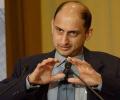
'There are deeper, underlying, forces at work and we need institutional arrangements to guard against them.'

The inflow of cheap capital has also kept the rupee at a high level, making exports uncompetitive and broadening the current account deficit despite falling oil prices.

Governor Rajan can be more unambiguously pro-growth.

While Manmohan Singh had to deal with high oil prices, inflation and trade deficit, Narendra Modi is lucky as major threats have receded, says T N Ninan.

Nationalisation has served its purpose. It's time to move ahead, keeping majority ownership of the government in a few banks to serve the people, argues Tamal Bandyopadhyay.

'Look at the number of billionaires, the number of new billionaires in India.' 'Adani and Ambani are not the only ones.' 'What's wrong with people making money as long as it benefits us?'
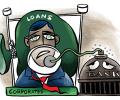
Given Indian corporates's high indebtedness, new credit will be used for servicing loans rather than building factories. This is setting us up for more companies on life support and more zombie banks, warns Rahul Jacob.
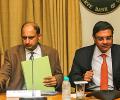
'It is likely the government may opt for an IAS officer.' 'For the government, an IAS officer will be more easy to deal with,' notes A K Bhattacharya.
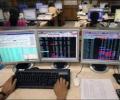
HDFC, TCS, RIL, ITC and ICICI Bank dragged the Sensex by over 100 points.

'The most important thing is that the psychological signal it is giving to the markets and international markets,' says former finance secretary Arvind Mayaram.

BSE Bankex, Healthcare, Capital Goods and Consumer Durables ended higher.

The breadth was neutral with 1,329 advances and 1,320 declines.
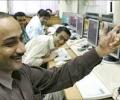
Markets ended in green on rate cut hope.

Chief Minister MK Stalin has shown that he is cut from a different cloth when it comes to embracing what is current, modern and absolutely necessary. Thus, even while retaining the spirit and content of the pan-Tamil, Dravidian socio-political and socio-economic ideology to the 't', his government has also acknowledged the need to accepting scientifically-proven facts in operational matters, says N Sathiya Moorthy.

Issuance of new bank licences proves that the apex bank wants the financial sector to flourish.
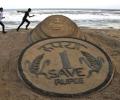
India's good fortune, experts in the US feel, is not the result of a fundamentally strong economy, but because it is the best of a bad set of options.

This gains importance in the backdrop of speculation on a second term for Raghuram Rajan.

Gains were led by index heavyweights with Reliance Industries contributing the most.

Make in India has few advantages and some disadvatnages too.

What does Nobel Laureate Abhijit Banerjee thinks about India's education sector?

The 30-share Sensex ended up 292 points at 29,571 and the 50-share Nifty closed up 75 points at 8,910.

'We first need to acknowledge the truth.' 'We are trying to diminish the problem and say, everything is okay and green shoots are emerging.' 'Imagine you are a doctor and not getting accurate medical reports, how do you diagnose and treat the illness?' 'We are not dealing with a terminal illness here, we are dealing with BP and cholesterol, which are imminently curable.'

The second fortnight of September saw Rs 3 lakh crore of time deposits, something unique, followed by liquidation of Rs 1.2 lakh crpre of these right after.

'Poor home work, and a subsequent loss of nerve.' 'This sums up the Modi government's current travails, the stall in key sectors, fading momentum, irritability,' points out Shekhar Gupta.

Global disinflation has finally caught up with India's high-cost economy.
.jpg)
Privatising public sector companies would have encountered significant opposition from their managers as well as from strong unions.
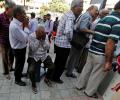
'I want the prime minister to be punished because he put our country in difficulties as he took this decision without Cabinet approval.' 'When he had already ordered the printing of new currency notes on May 19, 2016, why did he tell lies to the country?'

'I know of at least one techie who quit his job to join the AAP in Delhi. Many others traveled to India to volunteer during the election. If you ask these volunteers why they were doing it when they can't even vote in India, they say, "We want a corruption-free India".' Ritu Jha looks back on the year that was; it was party time, she says, for news junkies like her.

Several Sensex stocks hits 52-week low in intra-day trade on Monday with financials leading the decline.

Duvvuri Subbarao recounts how his tensions with P Chidambaram and Pranab Mukherjee, then finance ministers, over monetary policy spilled over into other issues in the central bank in this excerpt from Who Moved My Interest Rate?, his memoir of his term as Reserve Bank of India governor.

Economist Dale W Jorgenson declares that India is doing "very, very well" and forecasts that India might continue to outrun world economies, including China over the next many years.

The finance minister is "reasonably confident" that when it comes to the crunch, "it would be extremely difficult even for the Congress party to take a contrarian view" on the GST Bill.

'I want to leave behind the bank stronger and better than when I took over.'
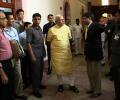
The Modi PMO is like none other: It is staffed by people who are so low profile that the only dominant personality is the Prime Minister's.
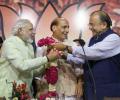
Modi has the ideas for a new, hopeful India, and an idiom in which to sell optimism to voters. But he doesn't yet have the team for it, and soon enough, questions will begin to be asked by an impatient, non-ideological, I-don't-owe-anybody-anything generation of Indian voters, says Shekar Gupta.
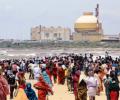
How on earth did Dr Manmohan Singh and his ministers conclude that the casualties of a disaster in a nuclear plant would be fewer than the deaths and injuries caused by the Bhopal gas tragedy? And that the compensation could, therefore, be capped at a smaller amount, asks T V R Shenoy.

'The approach towards Mallya is not right because his unit could have been turned around earlier with additional funds from his side and the bank's side.'

A majority of India's billionaires gained wealth in the last one year in spite of the stock market decline.
 © 2026 Rediff.com - Advertise with us - Disclaimer - Privacy Policy - Sitemap - Feedback - About us - Terms of use - Grievances